Exploring New Creativity in Automotive Sound Design Together with AI

I recently had the opportunity to deliver a keynote speech at the KSNVE conference on the theme of “AI-SQ Engineering × Creative Sound Design for Future Automotive Sounds.”
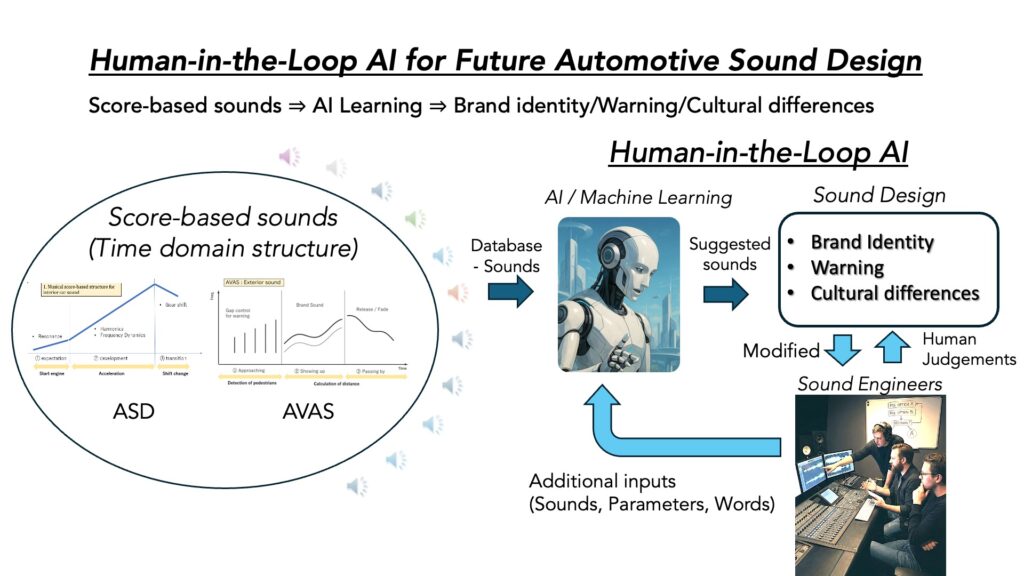
In my presentation, I discussed sound quality evaluation, sound design through “score-based” approaches, AI-assisted sound exploration, and the future possibilities of Human-in-the-Loop AI in automotive sound design.
One question from the audience left a particularly strong impression on me:
“Do you think this future will arrive in five years, or ten years?”
My answer was that, considering the rapid progress of generative AI in the fields of images, music, and creative applications, we may begin working with Human-in-the-Loop AI approaches in automotive sound design within the next three years.
However, what I consider even more important here is not simply the speed of technological progress. Rather, it is the fundamental difference between how humans and AI learn.
Humans do not understand sound only through equations or physical models. We perceive sound through sensory impressions, emotions, memories, cultural backgrounds, and accumulated experience. When a sound designer listens to a sound, the judgment is supported not only by numerical data, but also by intuition, context, and professional experience.
AI, on the other hand, learns patterns and relationships that exist within large amounts of data. From these, it can identify structures, similarities, and possibilities that humans may not immediately notice.
In other words, even when humans and AI are dealing with the same “sound,” the way they perceive it, the way they learn from it, and the world they see are different.
I believe that this difference itself may become a source of new creativity.
The future of automotive sound design will not be about AI replacing sound designers, nor about AI creating sounds entirely on its own. Rather, through collaboration with AI, new possibilities may be suggested, while humans evaluate, interpret, modify, and give meaning to them. In this way, a new collaborative process may emerge.
The concept of Human-in-the-Loop AI represents exactly this form of collaboration. AI can help us discover sound concepts that we have not yet recognized. At the same time, human judgment remains essential in connecting those concepts to meaningful experiences, such as brand identity, warning sounds, emotional expression, and cultural differences.
This idea is closely related to what I call “Strata of Sounds” — the notion that automotive acoustics continues to reveal new layers of meaning, design, and technology over time.
Especially as electrification and future mobility continue to advance, the sound of vehicles is becoming more than a mere by-product of mechanical systems. I believe that sound will become a medium for communication, identity, safety, and emotional experience.
Through collaboration between humans and AI, a new and still-unseen layer may open up in automotive sound design.
Finally, I would like to express my sincere gratitude to the organizers of KSNVE for giving me this valuable opportunity, and to all the participants for taking part in such inspiring discussions.