
Reflections on My Presentation at the JSAE Spring CongressEV Sound Design through “Score-Based” Approaches and the Strata of Sounds

I recently had the opportunity to give a presentation at the JSAE Spring Congress on Score-based Sound Design, a sound design method for electric vehicles.
In this presentation, I introduced the idea of considering EV sounds, especially AVAS — Acoustic Vehicle Alerting Systems — not simply as warning sounds, but as sound experiences with a temporal structure.
Here, the term “score-based” does not necessarily mean writing sounds on a musical staff, as in conventional music notation. What is important is not only to understand sound through its instantaneous tone color or volume, but also to design how it changes over time and how it forms an impression.
The driving sound of a vehicle changes in relation to speed, acceleration, driver operation, the surrounding environment, and the vehicle concept. By focusing on how these changes are designed, we can consider AVAS, brand sounds, and future mobility sound design within the broader framework of Creative Sound Design.
During and after the presentation, I received a wide range of questions. Among them, two questions were particularly memorable: what exactly is meant by “score-based” sound design, and what does it mean to think of EV sound as a “string instrument”?
What I emphasized was that I do not regard EV sound as something that can be created freely in any arbitrary way. Nor is the goal to make the sound of an electric vehicle resemble the sound of a string instrument itself.
Rather, the important point is how to create a sound that feels natural as a vehicle driving sound while embodying the concept of the vehicle and the direction of the brand. In this sense, I believe that EV sound has aspects that can be designed effectively by making use of string-instrument-like characteristics.
In other words, “EV sound as a string instrument” does not mean imitating the sound of a string instrument. It is one perspective for considering what an electric-vehicle-like driving sound could be, using the temporal and structural characteristics of string instruments as a clue.
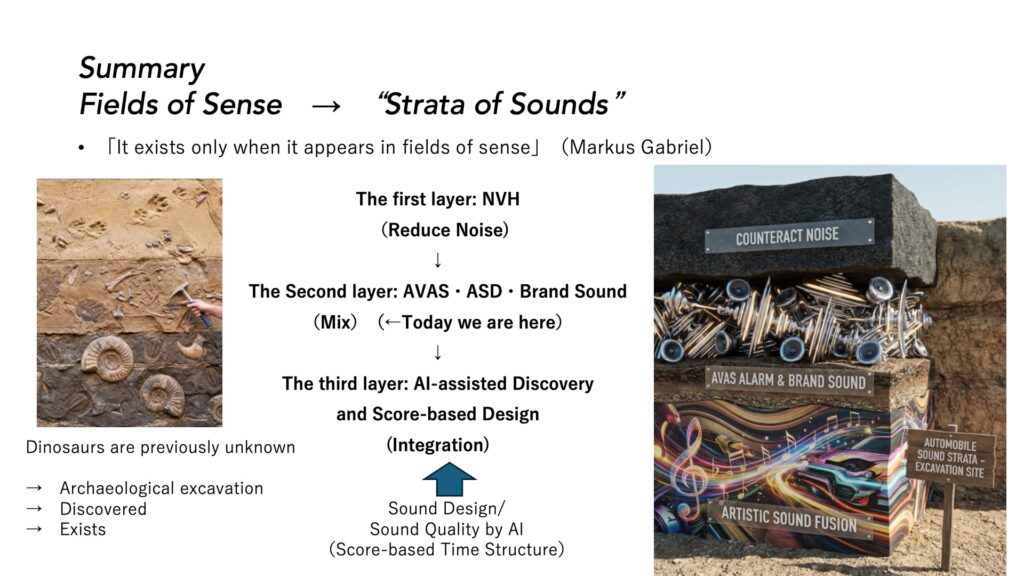
At the end of the presentation, I introduced the concept of “Strata of Sounds.”
This idea was inspired by the German philosopher Markus Gabriel’s concept of “Fields of Sense.” For example, dinosaurs existed long before humans recognized them. However, only after they were discovered, understood, and given meaning did they appear as something that “exists” within our world.
I believe that automotive sound may have followed a similar history.
The first major layer to emerge was NVH. In this layer, reducing noise and realizing quieter vehicles were important goals. Then, as vehicles became quieter, the next layer appeared: AVAS, ASD, brand sounds, and the field of sound design.
Looking further into the future, systems such as Human-in-the-Loop AI may reveal new layers of sound that we have not yet fully recognized.
What is important here is not to see AI merely as a tool for automatic generation, but as something that learns in a different way from humans.
Humans learn and understand sound through equations, physical models, emotions, experience, and bodily sensations through the five senses. When sound designers judge a sound, their evaluation is supported not only by theoretical understanding, but also by auditory impressions, bodily sensation, memory, and cultural experience.
AI, on the other hand, learns patterns and relationships that exist within large amounts of data. It can perceive the structure of sound in a way that differs from humans and present similarities and possibilities that humans may not immediately notice.
In other words, even when humans and AI are dealing with the same “sound,” the way they learn and the world they see are different.
I believe that this difference may be what awakens new creativity. AI does not replace human creativity. Rather, by showing the possibilities of sound from a perspective different from that of humans, it can help us discover sound concepts that have not yet become visible.
In this sense, the use of AI may open a new “stratum of sound” in automotive sound design.
Looking back at the history of automotive acoustics, it seems that we have always been excavating new strata of sound.
In the era of NVH, sound was mainly something to be reduced. In the era of EVs, sound became something that communicates safety and presence. In the coming era, I believe sound will become an important medium that shapes brand identity, emotion, culture, collaboration with AI, and future mobility experiences.
Perhaps the work of engineers and sound designers is not only to create sounds, but also to discover sounds that have not yet been found.
Through this presentation and the subsequent discussions, I was able to further deepen my thinking about the possibilities of EV sound design and the concept of “Strata of Sounds.”
I would like to express my sincere gratitude to everyone who attended the presentation and shared their questions and comments.