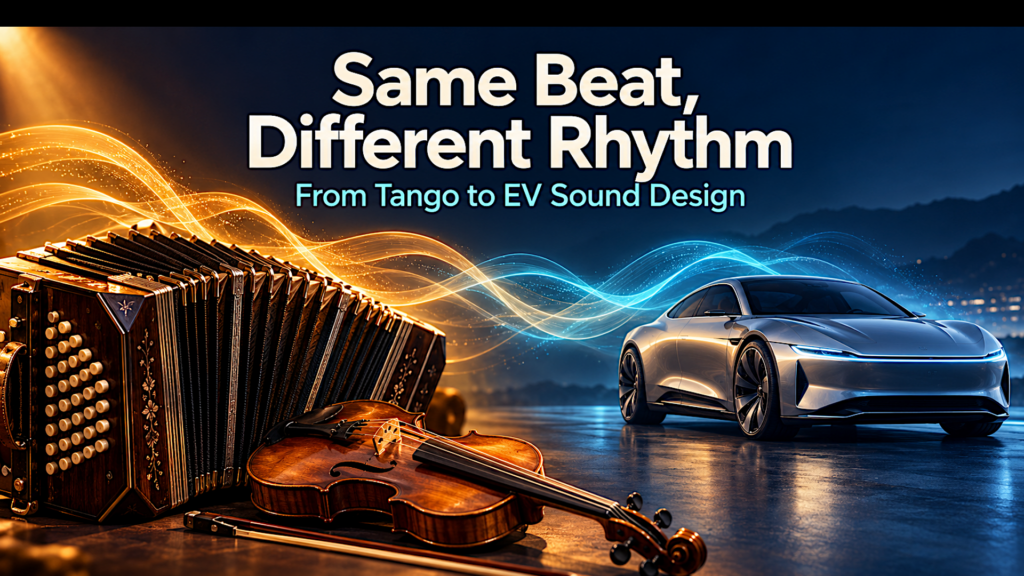
Same Beat, Different Rhythm: Reflections on EV Sound Design from My Work with Argentine Tango

1. A New Approach to Sound Design in the Bentley Torcal
Bentley Motors incorporates sounds played on real musical instruments into the “Bentley Dynamic Symphony,” the sound of its electric Torcal [1]. What interests me is the decision to focus on the rhythm and emotional appeal of a V8 engine sound, rather than simply imitate it.
According to Bentley’s official materials [1], the development team recorded and analysed a V8 engine, exploring its appeal through rhythm. They also compared playback of the engine sound with a drummer’s performance, finding similarities in their energy and emotional impact. Following these explorations, they created a new sound using performances on drums, viola, bass guitar and other instruments.
I see this as an approach that broadens the focus from physically reproducing an engine sound to recreating the appeal people experience in it. I previously introduced the Torcal’s sound design on this blog.
Yet when I first learned about this announcement, it reminded me of my work with a tango ensemble. Drums are not necessarily required to create rhythm. Could adding clearly defined percussive attacks actually make certain forms of rhythmic expression harder to hear? This question became the starting point for the present discussion.
2. What Tango Performance Taught Me about Beat and Rhythm
I used to handle live sound mixing and CD production for a tango ensemble. One thing I learned through that work was that beat and rhythm are not the same. The beat provides a temporal reference for a performance. But the rhythm we actually hear is not made up solely of sounds that mark the beat.
In tango, differences extend beyond duple and quadruple metre to the grouping of beats and the placement of accents. For example, performers may organise the music into groups of four beats, emphasising beats 1 and 3. They also give rhythm its expressive character through the way sounds enter, their length and their dynamics around the beat, rather than merely placing notes on it. The beat serves as a reference, while musical expression also takes shape around it. The bandoneon and string instruments such as the violin and double bass differ in how their sounds begin, sustain and decay. Each instrument has its own temporal shape, and their interaction gives tango its distinctive vitality and tension.
What particularly stays with me is the way the music would build like a wave towards the next beat. Before the beat, there was a sense of rising towards the next emphasis; at the beat itself, a clearly defined attack emerged. The sound then carried its resonance and decay into the next movement. No single instrument created this on its own. Alongside the attack, sustain and decay of each instrument, the sounds overlapped and responded to one another, forming a continuous temporal flow. I heard them as a connected musical movement, rather than as separate, independent sounds.
Later, when I read Link and Wendland’s book on tango performance, Tracing Tangueros: Argentine Tango Instrumental Music [5], the terms marcato, síncopa and arrastre resonated strongly with me. The movements I had heard in live performance were being described in words as performance techniques.
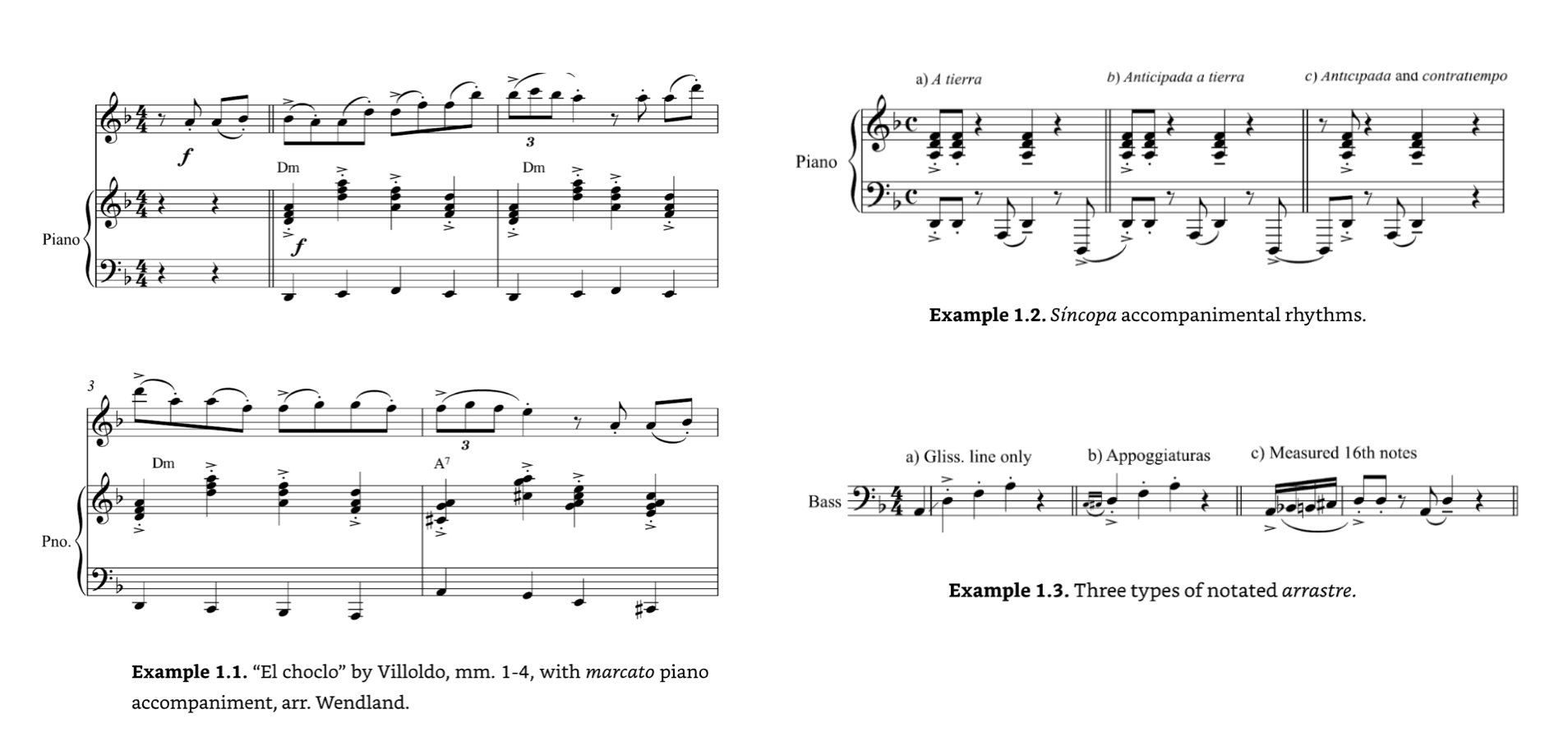
Example 1. Tango performance techniques: marcato (left), síncopa (upper right) and arrastre (lower right). Source: Tracing Tangueros: Argentine Tango Instrumental Music (2016) [5], Examples 1.1, 1.2 and 1.3. The excerpts show how these techniques and rhythmic expressions are represented in notation.
At the time, I had not understood the performances in those terms. Reading the book later made me realise that the movements I had sensed in the music had been articulated as performance techniques.
In performance, the musicians would play, listen to one another, and adjust their expression as they checked how their sounds overlapped and how their timing related. They seemed to be exploring not only the quality of each individual sound, but also the rhythm and sonority of the ensemble as a whole. Through listening and repeated experimentation, they would arrive at an expression that felt right together. It was as though they were conversing through sound. Musical expression was taking shape through feedback, rather than through a one-way process of reproducing a score.
The book also discusses the relationship between melody and accompaniment, accompaniment patterns, and changes in articulation. Tango rhythm does not arise solely from one instrument marking the beat. It emerges from the interplay of melody and accompaniment, the characteristics of each instrument’s sound, and the musicians’ expressive choices.
3. What Was the “Optimal Balance” I Sensed in Live Sound and CD Production?
There was a question I often considered when working on tango sound. Bringing the bandoneon forward could communicate the music’s dynamism more strongly. On other occasions, bringing the strings forward would highlight the beauty of the melody and timbre, making a powerful impression on the audience.
Which was the right balance?
I had a feeling that an optimal sound balance existed somewhere. Yet reproducing a level balance that had worked once did not bring it back every time.
Of course, I was not analysing the timing of every individual sound. Over a piece lasting around three minutes, it is simply not possible in live sound work to capture and adjust every sound individually in physical terms. I listened to the performance as a whole: how was the music coming across that day, and how was it reaching the audience? That impression guided my judgement of the overall balance. Interestingly, the relationship between the sound engineer and the musicians was not one-way either. The musicians also heard the sound through the PA system, took in the way it blended and resonated that day, and reflected this in their playing.
The musicians, the sound engineer and the audience’s responses all interacted in shaping the music of that particular day. Within that process, there were moments when the sound resonated beautifully, the instruments came together, and a strong response came back from the audience. I would think: “Today, the sound really came alive.”
In CD production, too, what mattered to me was the rhythm created by the intertwining movements of the instruments’ sounds. Preserving that expression did not always call for bringing clearly defined attacks from percussive sounds to the foreground. In tango, both piano and violin can produce percussive sounds. Musicians in the ensemble also told me of occasions when adding drums had unsettled the rhythm, making the music feel less like tango.
This does not mean that percussion is unnecessary. Making the beat easier to perceive through clear attacks and conveying rhythm through the temporal relationships among several instruments are not necessarily the same thing.
Looking back on these experiences, I think that attack, sustain and decay, together with the temporal overlap of multiple sounds, influence how listeners experience rhythm. This is also consistent with the concepts of P-centers and microrhythm explored in recent research on music perception. In the following sections, I consider these temporal structures of sound from that perspective.
4. How Does Research on Music Perception Explain the “Centre” of a Sound?
Recent research offers some intriguing findings for thinking about this experience.
A sound’s physical onset does not necessarily coincide with the point people use as a reference when aligning something in time with it. This perceived temporal location is called the perceptual center, or P-center . Danielsen and colleagues’ 2019 study, “Where Is the Beat in That Note?” [2], investigated how attack, duration and frequency affect P-center location and variability.
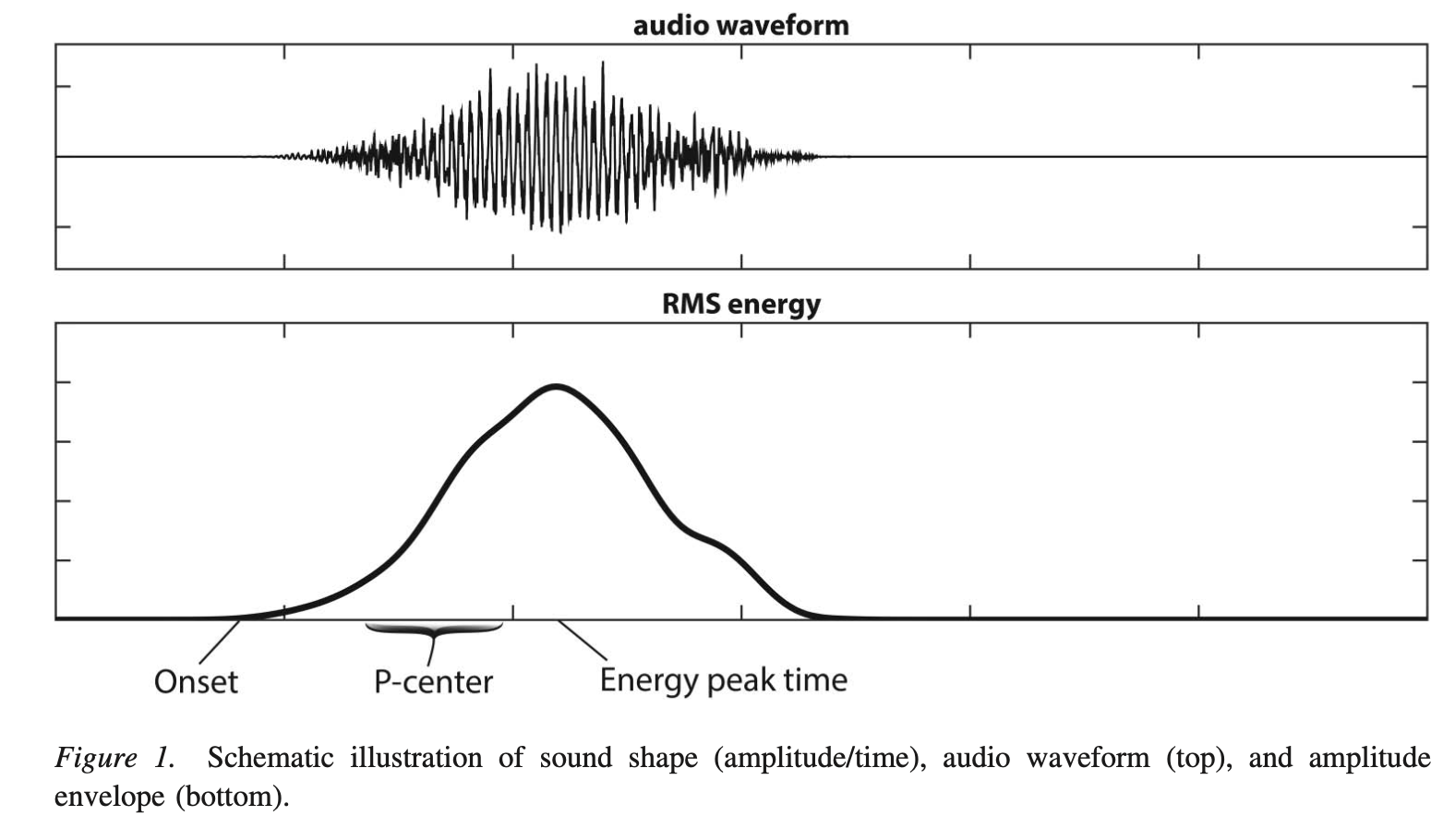
Figure 1. Waveforms and envelopes illustrating the concept of the P-center. Source: Danielsen et al. (2019) [2], Figure 1. The P-center does not necessarily coincide with the waveform’s onset or its energy peak.
The study found a tendency for sounds with slower attacks and longer durations to have later P-centers and broader distributions of synchronisation judgements. The authors describe a “beat bin” with a width and shape, rather than treating the P-center solely as a point. This width is not simply a matter of performance or judgement error; it offers a way to think about how one can align timing with a sound.
Selected results from the click-alignment task in Table A1 of the original paper are shown below.
| Sound used in the experiment | Mean P-center location relative to sound onset |
|---|---|
| Kick drum | +2.13 ms |
| Snare drum | +1.58 ms |
| Light piano | +3.90 ms |
| Dark piano | +9.00 ms |
| Arco bass | +12.04 ms |
| Synth bass | +23.44 ms |
Table 1. Selected click-alignment results from Danielsen et al. (2019) [2], Table A1. These are mean values for the particular sounds used in the experiment, not fixed values for the instruments in general.
The 2024 review “There’s More to Timing than Time: Investigating Musical Microrhythm Across Disciplines and Cultures” [3] places these findings in a broader context that includes musical culture, performance experience and musicians’ movements. Here, microrhythm encompasses not just small deviations in onset timing, but also interactions among attack, sustain, decay, timbre and relative intensity.
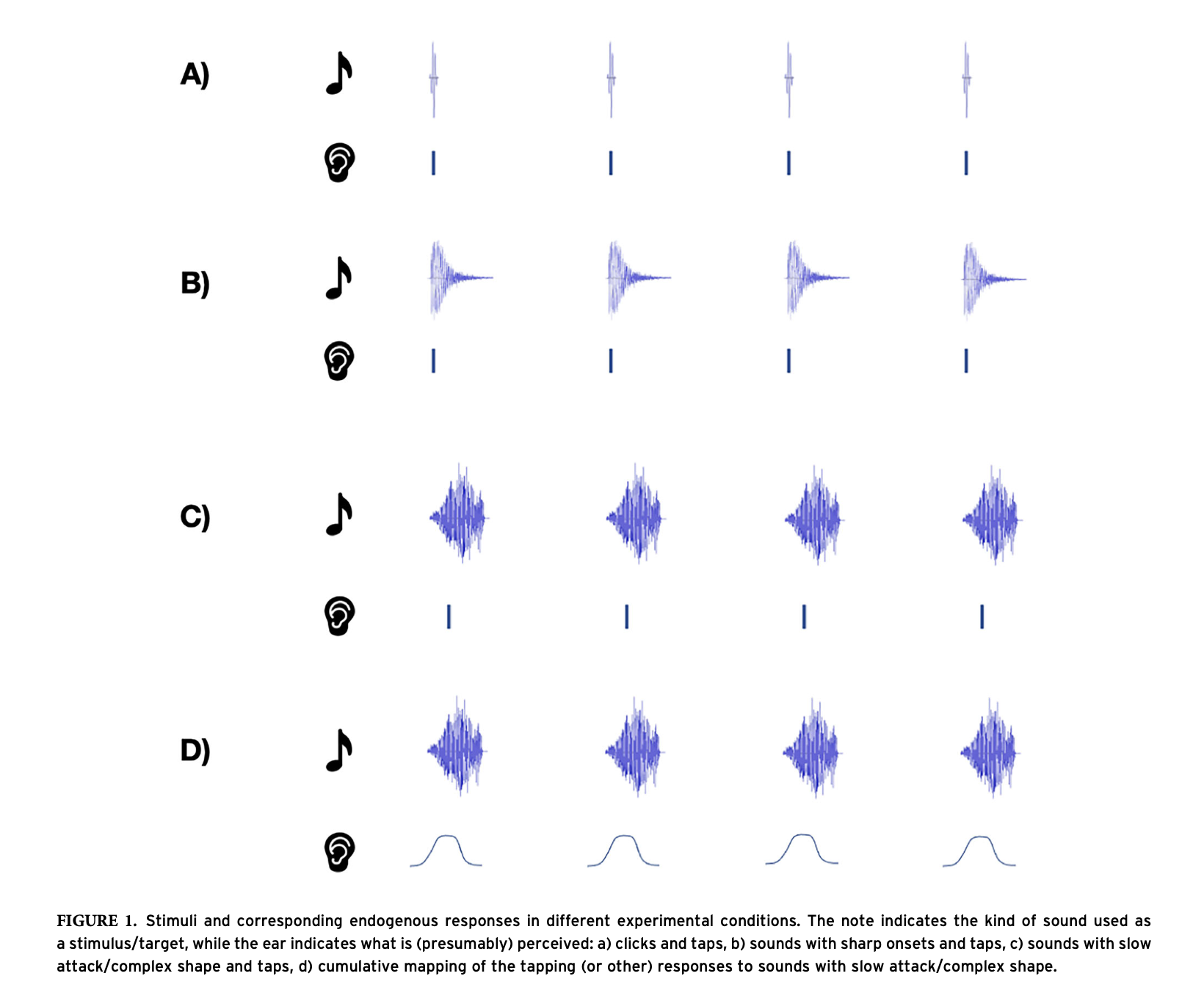
Figure 2. Ways of representing sound stimuli and perceptual responses. Source: Danielsen et al. (2024) [3], Figure 1. Notes represent sound stimuli and ears represent perception. This is a conceptual illustration of how experimental results can be understood.
| Row | Stimulus and response | Concept illustrated |
|---|---|---|
| A | A very short click and the response | Both sound and response can readily be treated as points in time. |
| B | A sound with a sharp attack and the response | Even when the sound has duration, the reference for the beat is concentrated near its onset. |
| C | A gradual, complex sound, with the response represented as a point | The location of synchronisation shifts later than the sound’s onset. |
| D | A sound like that in C, with a response represented as having width | The beat can be understood as a temporal region rather than just a single point. |
The review also presents an example in which sidechain compression changes a synthesised sound’s envelope. Using the kick drum to trigger a reduction in the synth’s level changes the way its sound rises and swells.
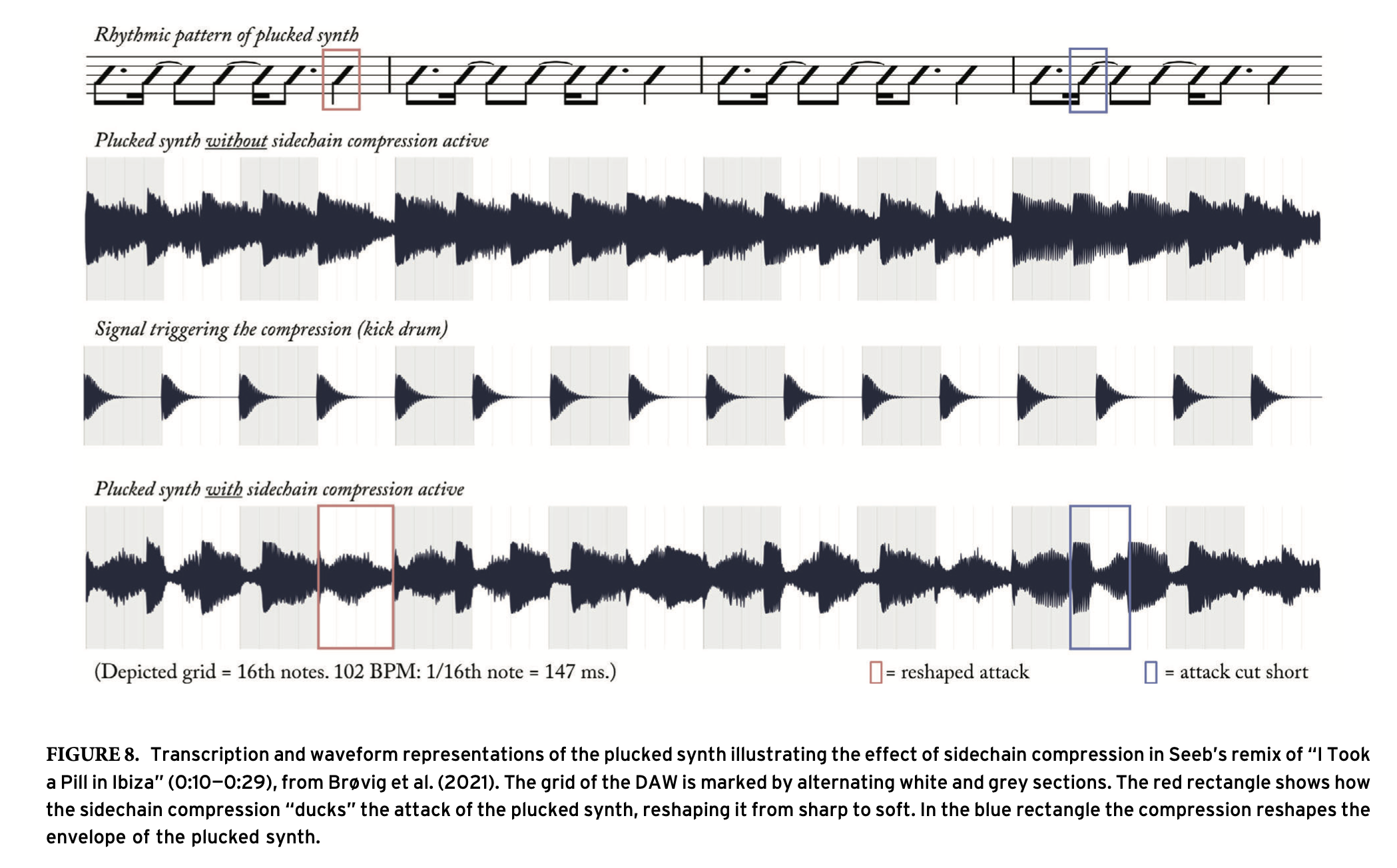
Figure 3. The synth sound before and after processing, and the kick drum that triggers the processing. Source: Danielsen et al. (2024) [3], Figure 8, based on Brøvig et al. (2021). In the red box, a sharp attack becomes more gradual; in the blue box, part of an attack is cut short. Reshaping the waveform in time provides a way to influence the perceived rhythm.
Even when the placement of note events is retained, changing how their acoustic energy unfolds over time can influence the experience of rhythm. For someone who creates sound, this is particularly interesting.
The review also describes an experiment in which three groups with different musical backgrounds chose different synchronisation locations for the same long fiddle sound.
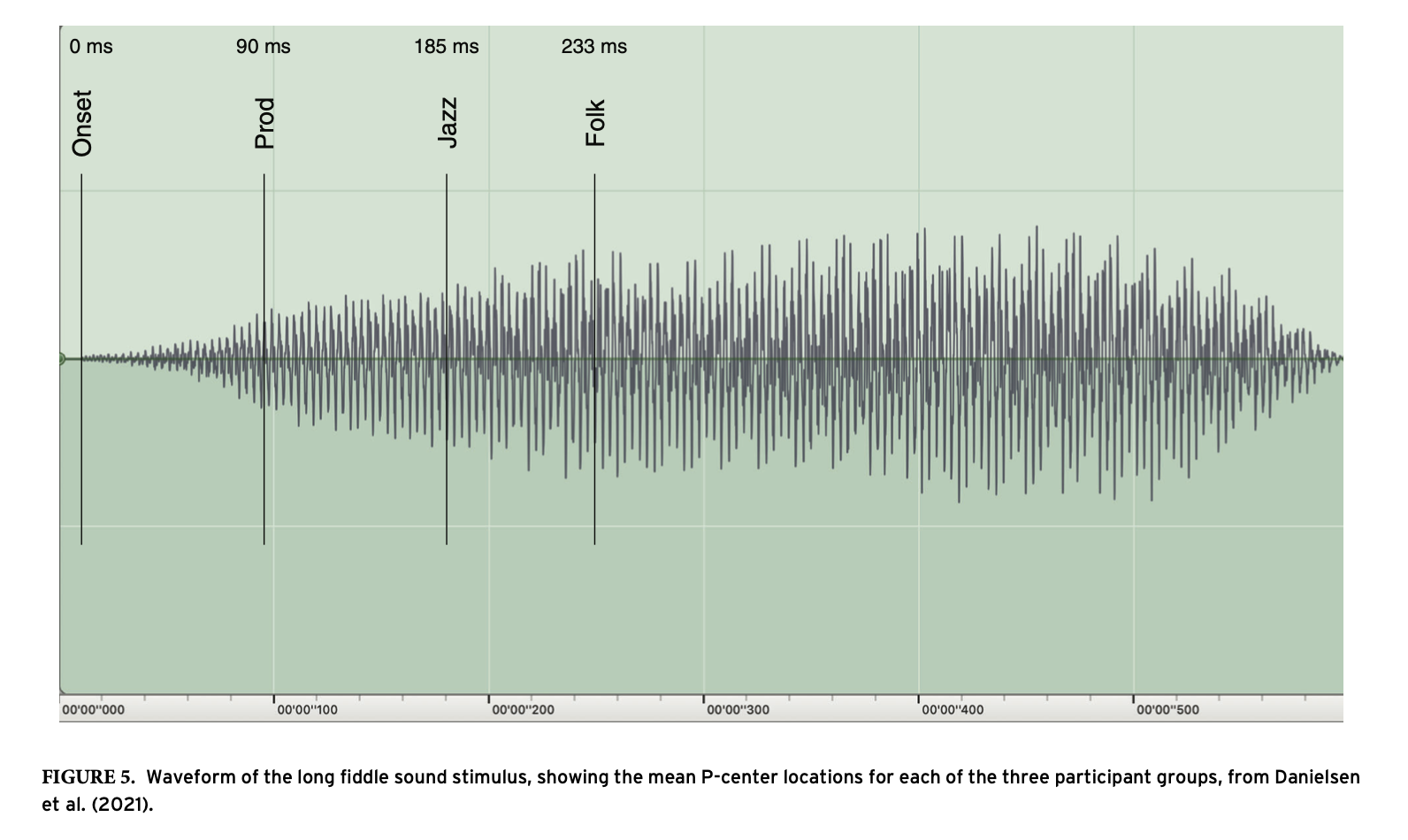
Here, “Folk” refers to traditional Scandinavian fiddle music. The result suggests that the music and performance practices people regularly engage with may be related to where they align their timing within the same sound.
These studies show that a sound’s physical characteristics and listeners’ musical backgrounds influence when the sound is perceived to occur. However, the beat shared throughout a performance and an individual sound’s P-center are not identical. The P-center offers a clue to how that sound relates to the shared beat. In that sense, the idea that the shape of sound around the beat contributes to rhythm perception resonates deeply with my experience.
5. Do Drums Dominate the Rhythm of Compound Sounds?
Danielsen and colleagues’ 2026 paper, “All About That Bass Drum?” [4], goes a step further, examining how the overall perceived temporal location is determined when sounds from different instruments are combined.
The experiments found that when sounds with sharp and gradual attacks were paired, the P-center of the compound sound tended to be drawn towards the sharper sound, such as the kick drum or hi-hat.
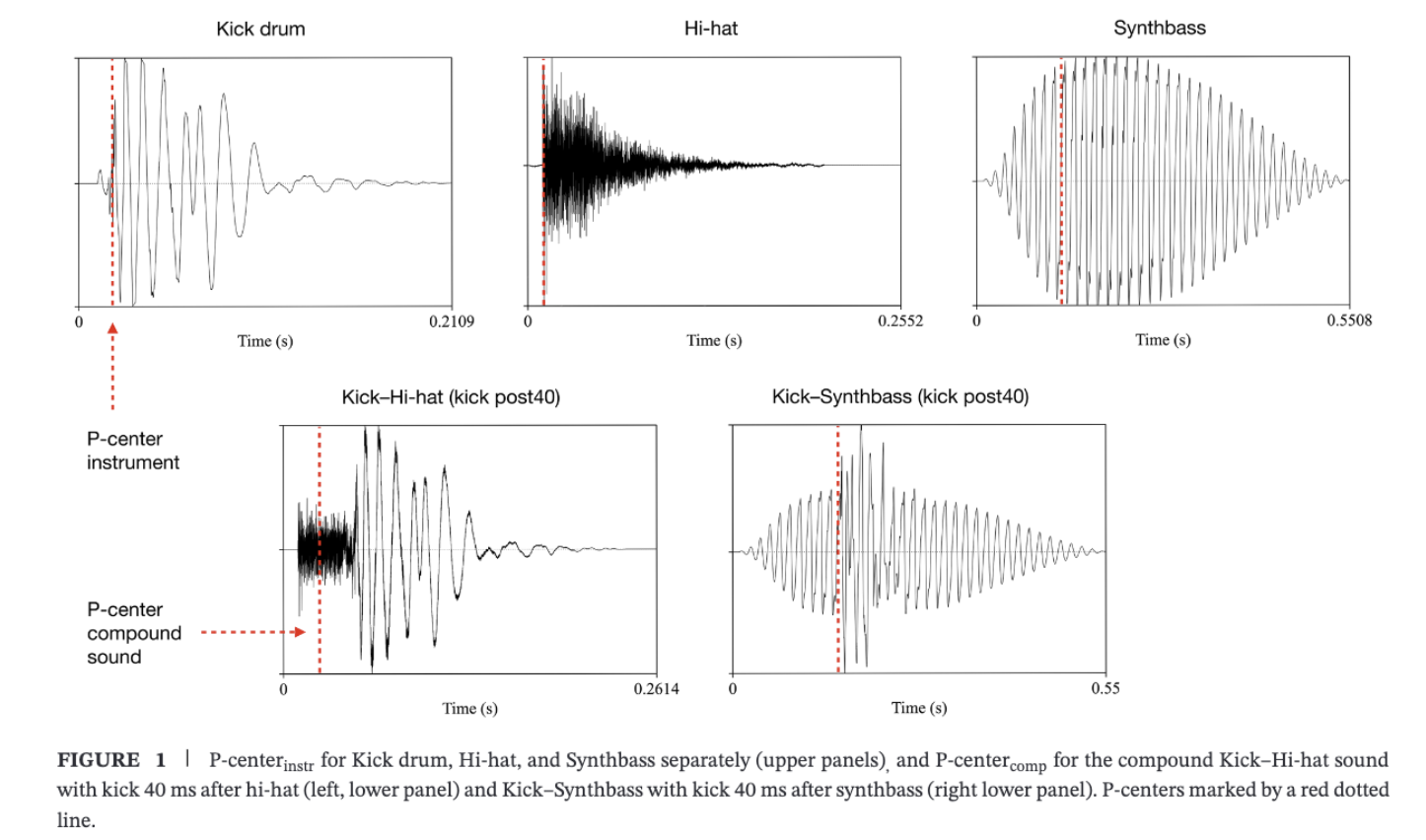
Figure 5. P-centers of individual and compound sounds. Source: Danielsen et al. (2026) [4], Figure 1. The experimental asynchronies were defined relative to the P-centers previously established for the individual sounds, not their waveform onsets.
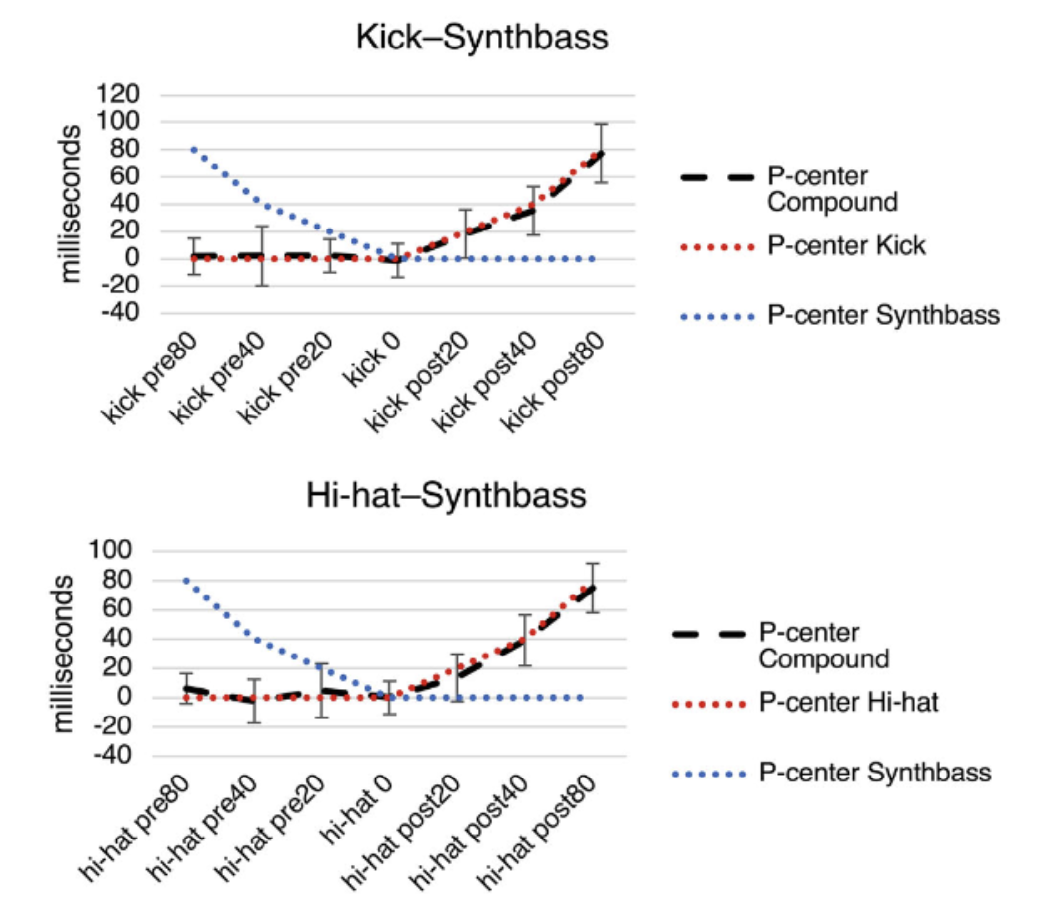
In Figure 6, the black line closely follows the red line. The overall synchronisation location does not simply settle halfway between the two sounds; it tends towards the sharper sound. When several instrumental sounds are combined, they do not necessarily contribute equally to the perceived timing.
The kick drum does not always dominate, however. The kick–cabasa pair was an exception to the general tendency for the faster-attack sound to attract the compound P-center. For the kick–hi-hat pair, the distributions of click-alignment responses became bimodal under some asynchrony conditions, suggesting that the sounds could be perceived as two separate events.
This study did not investigate tango performance, nor did it demonstrate that drums diminish its musical expression. Even so, it offers a way to think about the issue I had sensed. In light of these findings, I wonder whether bringing clear attacks to the foreground changed which sound listeners used as their reference for the beat, and consequently changed how they heard the temporal relationships between bandoneon and strings. This hypothesis grew out of my own experience, but the findings have helped me frame the question more concretely and in a form that can be tested.
Using drums to emphasise rhythm is an effective form of expression. At the same time, could the appeal of rhythms emerging from overlapping attacks and decays also become a design objective for the sounds of machines, without drawing everything towards a clearly defined percussive attack?
6. From the Score to Sound Shape and Perception
I previously proposed a method of representing temporal changes and the organisation of frequency components in sound design on a time–frequency diagram. I call this a “score-based” approach [6]. Its advantage is that it makes the composition of sounds, their changes and their relationships visible, allowing designers to share their intentions.
A conventional musical score contains not only notes, but also dynamics, articulation markings such as staccato, and playing techniques such as pizzicato. Nevertheless, it cannot fully describe the actual envelopes of sounds or the perceptual relationships that emerge when multiple sounds are combined. The same notes and instructions can produce different sounds depending on the instruments and musicians.
I would therefore like to combine the structural description provided by a score with acoustic analysis and listening evaluations. AI-based recognition of acoustic patterns could be one means of doing so.
Training a model to relate attack, sustain, decay, timbral change and interactions among sounds to listeners’ synchronisation judgements and assessments of rhythm might reveal features that conventional metrics have difficulty capturing. Those features could then potentially be connected to sound generation.
Recognising sound patterns, however, does not guarantee the ability to create appealing sounds. The generated sound must be heard, judged against the expressive intention, and revised. I believe this calls for a human-in-the-loop process involving sound designers and listeners.
7. Rhythm as Brand Identity
Finally, I would like to return to the sound design of the Bentley Torcal.
I am strongly interested in the idea of reconsidering the appeal of engine sound through musical rhythm. My experience with a tango ensemble also leads me to consider another possibility.
The tango master Osvaldo Pugliese’s La Yumba can be understood as a work that brings together various forms of tango expression and rhythmic elements within his distinctive musical language. The pull from low-register sounds or clusters towards a strong beat, the clear accent on that beat, and the low-register resonance on the following weak beat (“ba”) form a connected movement. As suggested by the onomatopoeic “YUM-ba,” strong and weak beats fulfil different sonic roles while forming a distinctive rhythm. I hear this coherent temporal movement as part of Pugliese’s individuality. It goes beyond marking the beat: accent placement, attack and sustain, and the instruments’ responses to one another combine to create a distinctive rhythm and musical identity.
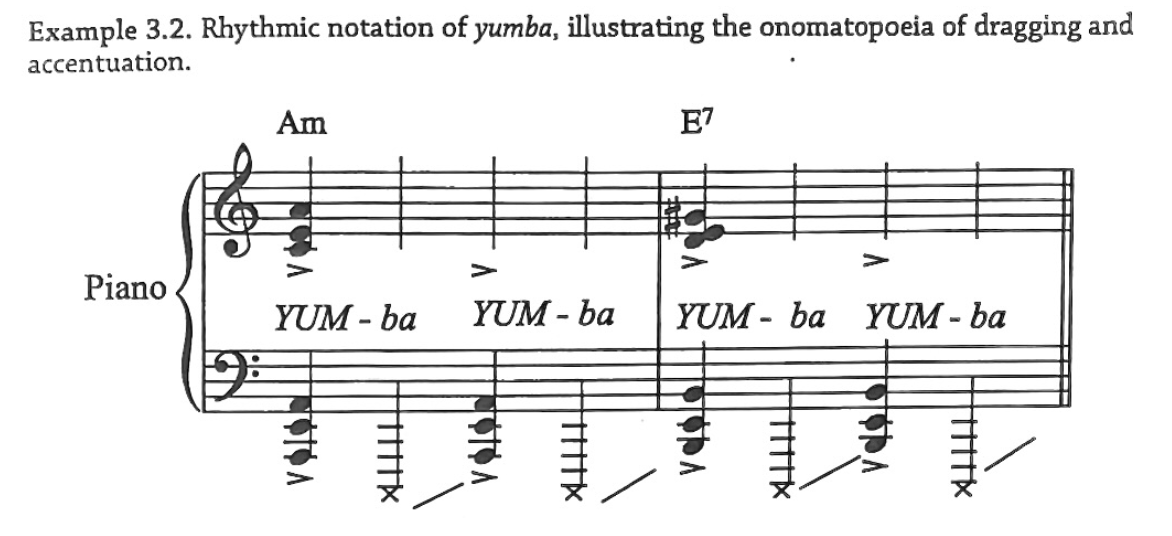
In EV sound design, too, could we create distinctive sounds by organising the temporal relationships among multiple sounds, extending beyond engine imitation or conveying acceleration through level, frequency changes over time and harmonic components alone?
What matters is not only the characteristics of individual sounds, but how they overlap, respond to one another and form a continuous temporal flow. The resulting unity of sound and rhythm could give a vehicle its own musical character, potentially contributing to brand identity. Taking the periodicity of engine sound as a starting point, could changes in how sounds swell, decay and overlap express a different sense of rhythm and dynamism? In particular, I would like to bring temporal relationships like the intertwining of bandoneon and strings into acceleration sound design, without using drums.
This proposal is not based on a judgement that drums perceptually dominate the Torcal’s EV sound. Rather, the papers discussed here have prompted me to explore another direction in sound creation. Nor can findings about musical beats be applied directly to the rapid periodic fluctuations in engine sound. We need to examine how drivers perceive the relationship between temporal changes in sound, vehicle acceleration and their driving inputs .
I intend to explore this possibility by bringing together acoustic analysis, AI-based pattern recognition, sound generation and human listening evaluations.
Rhythm is more than marking the beat. It is also about how sounds emerge, resonate and fade. Within that temporal structure, there may be a world of sound design still waiting to be discovered.
References
- Bentley Motors. The Sound of Bentley — Torcal ; Torcal Range . Official sources for the development approach, the instruments used and the name Bentley Dynamic Symphony.
- Danielsen, A., et al. (2019). Where Is the Beat in That Note? Effects of Attack, Duration, and Frequency on the Perceived Timing of Musical and Quasi-Musical Sounds . Journal of Experimental Psychology: Human Perception and Performance , 45(3), 402–418.
- Danielsen, A., et al. (2024). There’s More to Timing than Time: Investigating Musical Microrhythm Across Disciplines and Cultures . Music Perception , 41(3), 176–198.
- Danielsen, A., London, J., Langerød, M. T., & Câmara, G. S. (2026). All About That Bass Drum? Asynchrony Effects on the Perceived Timing of Compound Musical Sounds . Annals of the New York Academy of Sciences , 1560, e70306.
- Link, K., & Wendland, K. (2016). Tracing Tangueros: Argentine Tango Instrumental Music , pp. 6–11, 28–31, 90–98. Oxford University Press.
- Kubo, N. (2026). Proposal of a Score-based Sound Design Method for Electric Vehicles. JSAE Spring Congress . Paper in Japanese.